

.
.
Belonging
In 2020, I started researching the lives of my Armenian grandmother and her two sisters in Turkey where they lived before emigrating to the US. As I made connections with other Armenians, and Genocide and Ottoman scholars, one connection led to another and then to Zeynep Gürsel, a professor of anthropology researching the photographs taken of Armenians before they left Turkey. Even though Gürsel’s research focused on specific kinds of photographs (see blurb below), she was gracious enough to look at my family photographs. Of the above photograph, she wrote, “It was a pleasure to see all of your images but the one of the four young women in particular has stayed with me. What a beautiful family. Noemi, Matilda, Haigouhi, Sirvart Haigazn. Haigouhi’s haircut is particularly modern.”
For me, this 1926 photograph was proof that my grandmother Matilda was back with her mother Noemi, and sisters Silvia and Hilda (the names I knew them by) in Constantinople after being separated from them in 1919. I was intrigued by Gürsel’s remark on Hilda’s hairstyle. Perhaps attending American missionary schools influenced her choice. Or living in cosmopolitan Constantinople. Or the influence of Mustafa Kemal Atatürk, the Republic of Turkey’s first president, albeit president for life, and his push for adopting Western ways of dressing.
I’m grateful for Gürsel’s willingness to connect and engage with me and my family photos. She added information to my search and made me feel less alone on my research journey. She ended our final email exchange with: “In order for me to tell the stories of the Ottoman Armenian families with the richness I hope to it is paramount that I understand something of the texture of their lives. I’ve looked at all the images in Project SAVE but it is one thing to encounter an image in an archive and another all together to look together with someone who cares about the photographs differently. Thank you for this gift.”
Unbelonging
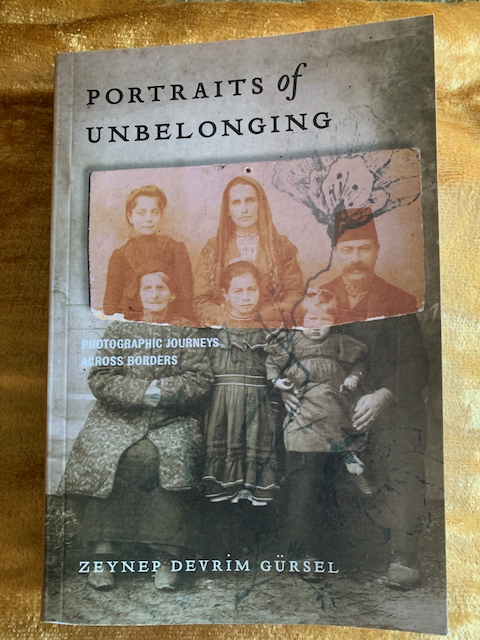
This year Zeynep Gürsel published her research in a book aimed at laypeople. Her book is on my nightstand waiting in the queue of my to-read pile. From the back of the book:
“In 1896 the Ottoman sultan issued a decree that allowed Armenians—and only Armenians—to emigrate, on the condition that they expatriate and never returned to their homeland. A key step in this process was sitting for a photograph. More than a century later, Zeynep Devrim Gürsel encountered these photographs in the Ottoman state archives and began following the stories of the people they pictured—from the bureaucratic files that unmade them as Ottoman subjects, to the naturalization records that documented their new lives as immigrants, and into the family albums of their children. An intimate history of one of the earliest uses of photography for border control and exclusion, Portraits of Unbelonging: Photographic Journeys Across Borders is an invitation to learn from lives lived in radically uncertain times.”
.
.
* * *
.
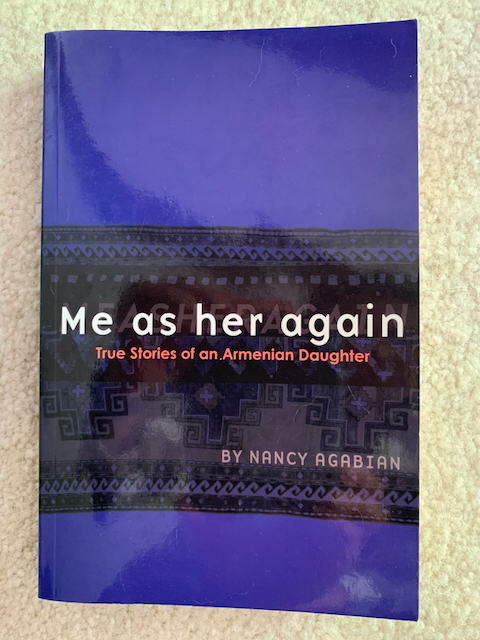
Books: Me As Her Again, by Nancy Agabian, is a memoir of a young woman looking back at her childhood to see the connections between her past and her present. It’s also a memoir of an Armenian-American searching for understanding of and connection to her heritage which includes learning about the history of Armenians including the Genocide. Much of that history I have read about elsewhere, but Agabian also delves into the division among Armenians between those that mostly want Turkey to acknowledge the genocide so there can be some repair and reconciliation, and those that believe those first steps must be followed by reparations—financial compensation and a return of land.
.
.
* * *
.
Work-in-Progress: I’ve touched my manuscript six days out of the last twenty. Besides the obvious slow progress on my WIP, not sitting at my desk regularly has also affected my overall well-being. I feel less grounded. More stressed. I miss the flow of creation, of making connections, of revision. I’ve tried to view the life events that have kept me from my desk with equanimity. A friend sent me this Ram Dass quote “You can do it like it’s a great weight on you or you can do it like it’s part of the dance.” I strive for the latter.
.
* * *
.
Do you have old family photographs? Or is there a designated family “historian” who stores them? What do we do with old family photographs? In what ways are they valuable? Is there a point when photographs lose their meaning? Do we make sure photographs have dates and names and places attached so future generation will know who they are? Will future generations care? I’d love to hear your thoughts in the comments.
.
* * *
.
Thank you for reading! Writing is a lonely endeavor and your presence here brightens my day!
.
.
Recent Comments